Starting ski lessons as an adult is different from learning as a kid. Your body is stronger and more coordinated, but your mind carries more fear. You might worry about looking ridiculous, falling in front of strangers, or wasting money if you're "not a natural." These concerns are real, and completely normal. The truth is that adult learners progress faster than you'd expect once you commit to lessons, and a good instructor removes most of the anxiety by setting realistic expectations from the start.
Adult ski lessons are one of the best investments you can make for your snow sports experience. Unlike trying to figure it out alone, structured lessons compress months of trial-and-error into days. You'll learn proper technique early, avoid bad habits, and reach the point where skiing feels fun instead of terrifying within a few sessions.
What Your First Lesson Actually Looks Like
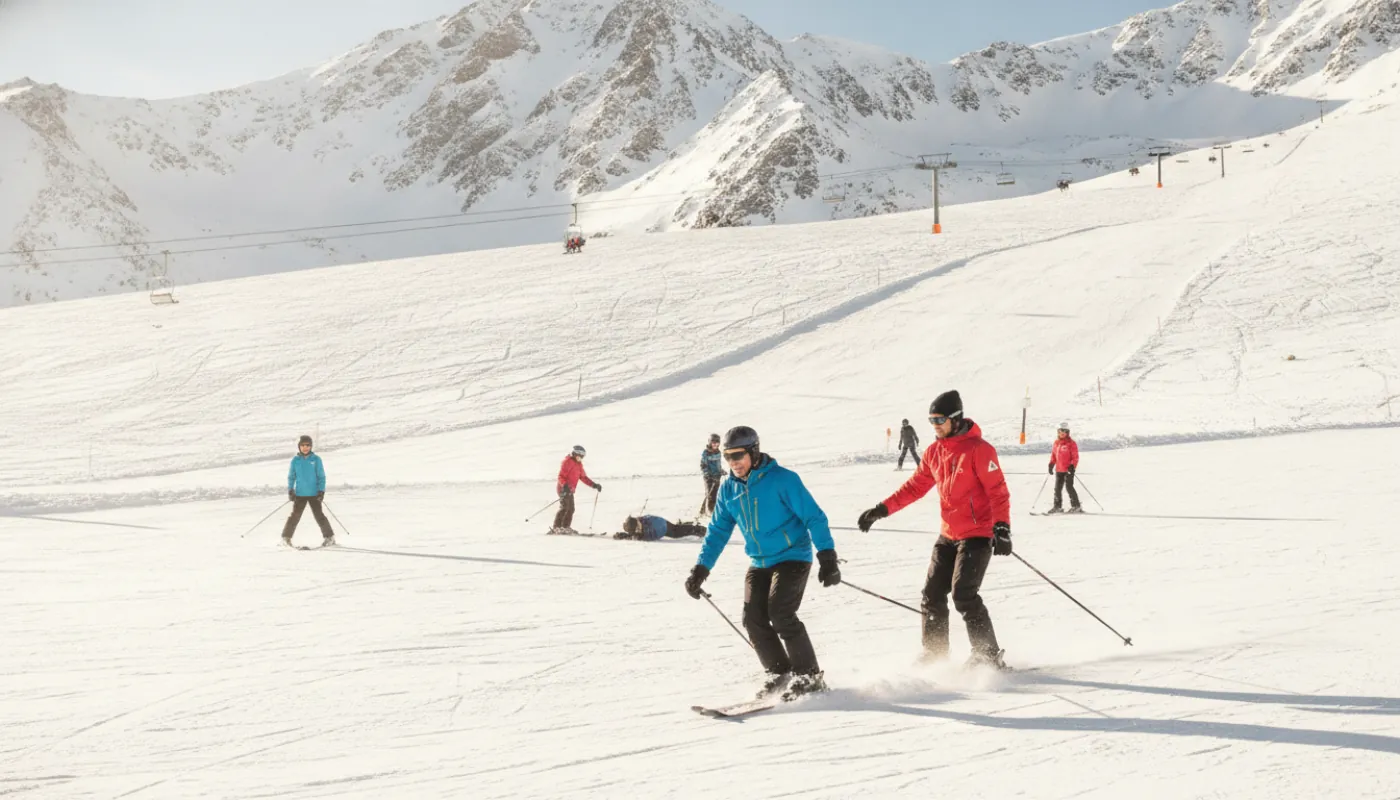
Your first lesson begins on the bunny hill, not the blue runs. A qualified instructor will watch you stand and move on skis before deciding where to work. Even if you've never skied, don't expect to spend the entire lesson in the snow: you'll do significant work off the slope first: learning how your equipment works, how to slide sideways, how to stop, and how your body responds to balance on a downward angle. The physical sensation of skiing is unlike anything else, and your instructor needs to let you acclimate instead of rushing downhill.
Expect to fall. Beginners fall multiple times per lesson, and this is not a sign of failure, it's proof that you're learning edge control and not just pointing downhill. A good instructor will teach you how to fall relatively safely and how to get up efficiently. After a few falls, most adults stop finding it traumatic. Your ego might bruise more than your body, but by the second or third lesson, falling becomes just part of the process. Wear padded base layers and wrist guards if you're nervous; this mental safety net lets you focus on technique instead of protecting yourself.
By the end of a 90-minute first lesson, you'll have made a dozen or so runs down the bunny hill, each one slightly more controlled than the last. Your legs will feel tired, you're using muscles you haven't isolated before. Your feet might hurt if your boots are too tight. You'll be cold. But you'll also have moved under your own power on skis, and that's a genuine achievement.
Group Lessons vs. Private Lessons: Which Is Right for You?
Group lessons cost far less than private ones (often $50–150 for a group session versus several hundred dollars for a private, with full-day privates at destination resorts running $900–1,700), and put you in a cohort of other learners at the same level. This removes some self-consciousness because everyone around you is also falling and struggling. Group lessons also work well if you're patient and don't mind a slower pace, you're sharing the instructor's attention with four to six other people.
Private lessons make sense if you learn better one-on-one, if you have specific goals (conquering moguls, racing technique), or if you have unusual physical limitations that require tailored instruction. Private instructors can adapt hour-to-hour based on what you're struggling with. If you're anxious about being watched, a private lesson actually reduces that pressure, one calm adult guiding you is less intimidating than five strangers observing your progress.
The honest answer: start with group lessons. They're lower cost, lower pressure, and perfectly effective for reaching solid-intermediate level. If you decide you love skiing and want to accelerate your technique, move to private lessons later. Many skiers never need more than a few group sessions.
Finding a Qualified Instructor: Why PSIA Certification Matters
Not all ski instructors are equally qualified. The gold standard in North America is PSIA (Professional Ski Instructors of America) certification, which requires demonstrated technical skill, teaching methodology, and continuing education. PSIA Level 1 instructors are certified to teach beginners on beginner and novice (green) terrain, exactly what a first-timer needs. Level 2 adds the intermediate (blue) zone, and Level 3 covers all terrain and expert skiers, so seek out a Level 2 or 3 instructor once you're working on more advanced skills.
Your ski resort or ski school likely has a website listing instructors and their certifications. Call or visit in person before booking and ask: "Do you have PSIA-certified instructors for beginner group lessons?" If the answer is unclear or vague, that's a red flag. Also ask whether your instructor specializes in adult learners, some instructors work better with kids, others with adults.
Online reviews on the resort's site or on Google give you a sense of who connects with adult learners. Keywords to look for: "patient," "encouraging," "explains clearly," "good for anxious skiers." Avoid instructors with reviews mentioning impatience or discouragement. Your first instructor sets the tone for how you feel about skiing going forward, so choose someone who energizes you, not someone who makes you feel rushed.
The Realistic Progression Timeline
Here's what actual progression looks like: after one to two lessons, you can snowplow (wedge stop) and turn on bunny hills with some control. After four to six lessons, you can navigate blue-run terrain comfortably if it's not crowded. After ten to fifteen lessons, you can link turns on more varied terrain and handle moderate bump runs.
The pace depends on your athleticism, your comfort with fear, and how frequently you ski. Someone taking lessons every weekend for a month will progress faster than someone taking one lesson per season. Most adult learners reach "solid intermediate" (the point where you're genuinely enjoying yourself, not white-knuckling down the mountain), within two to four weeks of consistent practice.
Don't expect to be an expert in a few lessons. Skiing is a skill sport, like tennis or surfing. Your body needs time to integrate what your mind has learned. Two weeks feels like a long time in the moment, but it's actually fast for developing the muscle memory and confidence to enjoy a full day on the mountain.
Permission to Be a Beginner
The biggest barrier for adult learners isn't physical, it's mental. You're used to being competent in your life. Skiing forces you back into beginner status, and that can feel awful. Permission slip: everyone on the mountain was a beginner once, and the people around you are far too focused on their own skiing to judge yours. Most other skiers remember what beginner lessons felt like and have nothing but goodwill for adult learners putting in the work.
Invest in lessons, commit to at least four sessions, and choose an instructor you connect with. By the end of those four days, skiing stops feeling impossible and starts feeling like something you actually want to do again. The anxiety fades faster than you think.