Flex rating might be the most misunderstood number in ski boot shopping. It's the first thing brands print on the box (70, 110, 150), yet most skiers choose boots without understanding what it actually means or whether that number suits their feet, ability, or skiing style. The result is thousands of people skiing in boots that work against them instead of for them. A flex rating that's too stiff leaves you fighting to initiate turns and shuts down responsiveness. Too soft, and you lose the edge control and power transfer that make skiing feel connected and confident. Get it right, and your boots disappear. They simply do what you ask.
Understanding the Flex Rating Scale
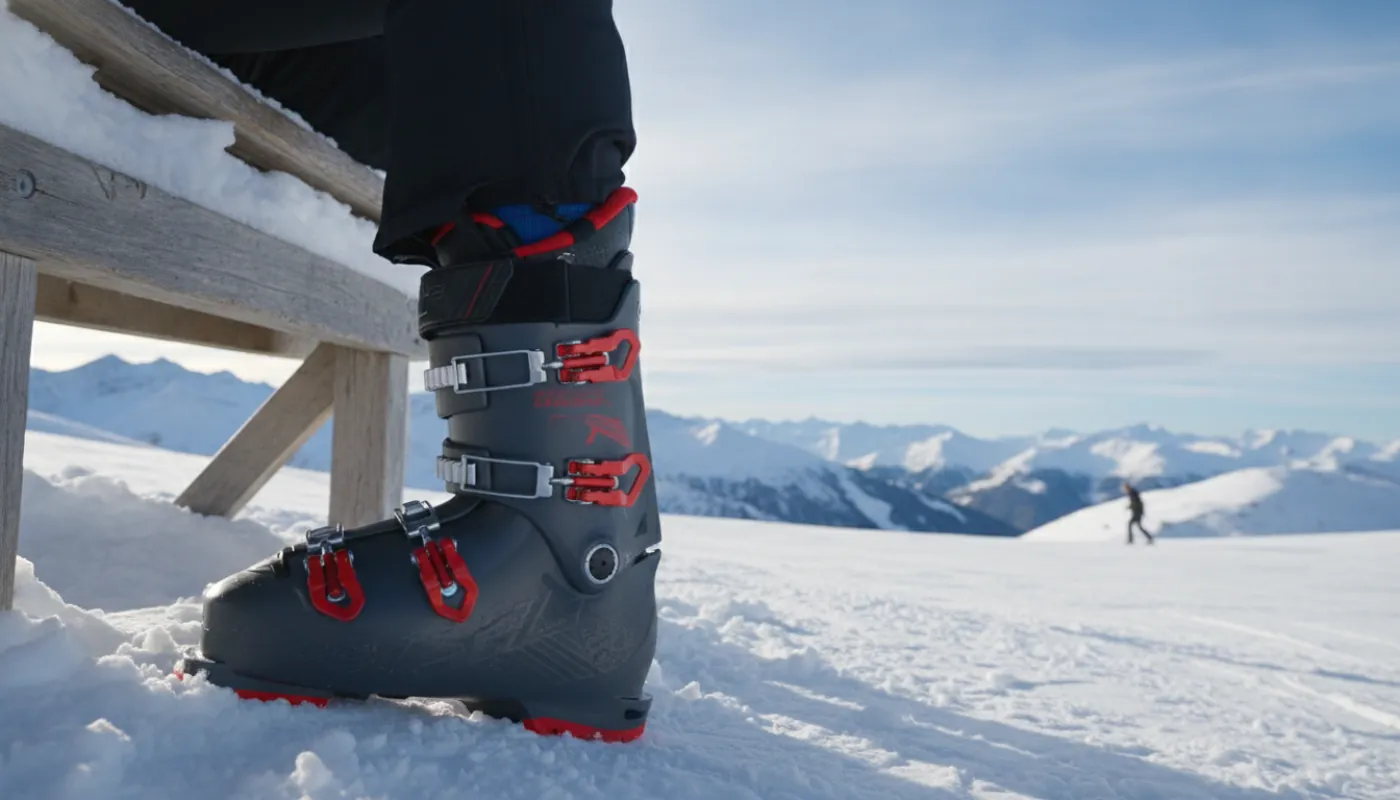
Ski boot flex ratings run from roughly 50 (ultra-soft park boots) to about 150 (race-bred machines). The number loosely reflects how much force it takes to bend the boot's cuff forward. Here's the critical catch most guides get exactly backwards: there is no industry standard for boot flex, and the numbers are not comparable across brands. Every manufacturer uses its own test method, so a Salomon 110 can feel noticeably softer or stiffer than a Tecnica 110, and even within one brand, a 130 race boot and a 130 touring boot won't match. Treat the flex number as a rough starting point inside a single brand's line, never as a spec you can cross-shop.
The scale breaks down into rough categories: anything under 80 is soft, 80–120 is medium, and 120-plus is stiff. But this linear scale doesn't feel linear when you're wearing the boot. The difference between a 90 and a 110 is noticeable but manageable. The difference between a 130 and a 150 is dramatic, you're essentially choosing between a high-performance boot and a race boot. Brands have started subdividing flex within categories (some make both 100 and 105 flex boots) to smooth out those jumps, which is helpful if you've narrowed your choice.
The flex rating tells you only one thing: roughly how much force your foot and shin must generate to bend the boot forward. It doesn't tell you ankle support, boot height, footbed shape, or calf fit. Those factors matter just as much, sometimes more. Flex is the entry point to the conversation, not the end of it.
Flex Rating and Individual Factors
Two skiers standing in identically-flexed boots will have completely different experiences because your personal physiology is the multiplier on that flex number. Heavier skiers naturally generate more force when they move, so a 110 flex boot will feel softer to a 200-pound skier than to a 130-pound skier. It's the same boot, but the effective flex is different. This is why generic advice about "beginners should buy soft boots" fails constantly, a larger beginner in an 80 flex boot might as well be skiing in a 60.
Your shin length and muscle mass also shift the equation. Tall people with longer shin bones have mechanical leverage; they can bend a stiff boot more easily than shorter people simply because of geometry. Muscular skiers, especially those who race or do a lot of moguls, generate the force to move a stiffer boot without fatigue. Skiers with less lower-leg development often can't activate a boot that's too stiff, and the boot becomes limiting rather than helpful. Gender is part of this too; average flex recommendations tend to skew high because the sport's equipment recommendations have historically been written by men and tested by men.
Your skill level and reaction speed also affect what flex feels right. Beginner skiers benefit from boots that respond quickly to small inputs, which means softer flex. Intermediate skiers working on edge control and rhythm often do better in medium flex boots that give them feedback without demanding perfect technique. Advanced skiers can ski anything because they move efficiently, but they usually prefer stiffer boots for the precision and power transmission. There's no threshold where a skier suddenly "graduates" to a stiffer boot, it's a gradual adjustment as your movements become more deliberate.
Matching Flex to Your Skiing Style
Different ski disciplines want different flex profiles. Groomed-run skiing, the bread and butter of most resort days, works well in the medium range: 100-120 flex. You get enough responsiveness to make quick turns and enough support to hold an edge on hard snow. Skiers focused on speed, whether carving fast on groomers or skiing steep terrain, tend toward the stiffer side: 120-140 flex. The extra resistance from the boot helps you maintain pressure through a turn and transfer power to the skis at high speeds.
Backcountry skiers often go softer than their resort counterparts, even if they're strong skiers. The reason is walking. Backcountry boots need to let your foot rock forward and backward for the walking stride, and a super-stiff boot fights that movement all day. Most backcountry boots fall in the 90-110 flex range as a compromise: stiff enough to carve when you're descending, soft enough that your legs don't burn out during the climb. Off-piste skiing and powder often benefits from slightly softer flex too, since the boot's job in soft snow is less about supporting a carved edge and more about cushioning impacts and staying connected to the skis' flex pattern.
Park skiers and jibbers often choose boots on the softer end, 80-100 flex, because they need maximum ankle mobility for tricks and a boot that absorbs impacts from rails and boxes. The softer response also means faster pivots and easier tweaking mid-air. Mogul skiers tend toward medium flex, sometimes slightly stiffer (110-130), because moguls reward strong edge control and precise pressure management on each bump. A softer boot gets deflected around moguls; a stiffer boot holds the line you choose.
The Most Common Flex Rating Mistakes
The biggest error is choosing flex based on ability level alone, without accounting for your body. This shows up constantly: a heavier beginner gets told to buy an 80 flex boot because "beginners should start soft," doesn't get the response they expect, and blames their own lack of skill instead of the equipment mismatch. The opposite also happens, a lightweight intermediate skier buys a 120 flex boot because they've read that "intermediate skiers need medium flex," then struggles to engage the boot and gives up on skiing.
Another common mistake is buying based on what you want to do, not what you actually do. You take one backcountry trip a year and the rest of your time is groomed runs, but you buy a soft backcountry boot because it sounds adventurous. Then you spend 50 days a season frustrated by how chatty the boot is on hard snow. Boot choice should be built around your actual skiing 80% of the time, with secondary considerations for the 20% that's aspirational.
Confusing stiffness with support is another trap. A stiff boot is not automatically more supportive, and a soft boot isn't automatically less stable. Support comes from shell structure, footbed design, and how well the boot holds your foot in place. A soft boot with an aggressive arch support and a tight heel pocket can feel more supportive than a stiff boot with a generic footbed. They're different properties. Some skiers conflate them and end up in the wrong boot chasing an imaginary solution.
Making Your Boot Flex Choice
Start with a realistic assessment of your body, not an aspirational assessment of your ability. If you weigh over 180 pounds, assume you'll want 10-15 flex points higher than lightweight recommendations. If you have less lower-leg muscle development, go 10 points softer. If you're an advanced skier in that same lighter-weight category, you might go 10 points stiffer. These aren't rules, but they're realistic adjustments based on how flex actually works in practice.
Next, nail down what you actually do. Log your skiing mentally: are you groomed-run focused, powder-chasing, backcountry-bound, or split between two of those? Choose the flex rating that serves your primary discipline, then make sure the boot's other features (calf fit, footbed shape, ease of entry) work for your secondary skiing. If you're torn between two flex ratings, pick the softer one and ski it for 20 days. The break-in process softens the boot slightly, and you'll quickly know if you need to return it for a stiffer option.
Finally, trust your test-drive. Rental boots are your friend here, most shops let you demo boots for a day or a few days for modest fees. Rent the two flex options you're between and ski them side-by-side on the same terrain. You'll feel the difference in responsiveness, energy feedback, and how much effort is required to initiate and complete turns. Your feet will tell you the answer more reliably than any review or forum post.