The first question every new backcountry skier asks is "which avalanche course should I take?" The answer is "Recreational Level 1", but the actual education progression that follows is more nuanced than most online guides explain.
This is a course-by-course walkthrough of the avalanche education path in North America, written from conversations with guides and educators rather than course-catalog copy.
The two governing bodies
Two main organizations issue and standardize avalanche education in the US:
- AIARE (American Institute for Avalanche Research and Education), the dominant provider for recreational and most professional non-guide-cert education. AIARE 1, AIARE 2, AIARE Rescue, Pro 1, Pro 2.
- AAA / A3 (American Avalanche Association): accredits courses, maintains the Pro curriculum standard, and operates the certification framework that guide associations require.
Canada has CAA (Canadian Avalanche Association) running a parallel system. Most US recreational courses are AIARE; most US pro/guide courses are AIARE Pro under A3 standards.
The course names you'll see ("Avy 1," "Rec 1," "Level 1," "AIARE 1"), are mostly the same thing. AIARE 1 is the standard.
The recreational progression
AIARE Rescue (1 day)
- Who it's for: Anyone planning to travel in avalanche terrain. Should be taken first or alongside Rec 1.
- What you learn: Beacon, shovel, probe practice. Companion rescue. Multiple-burial scenarios. The course is mostly hands-on practice, you'll spend hours digging.
- Cost: $150–250.
- Honest take: This is the highest-ROI single day of avalanche education. Many courses bundle it with Rec 1. If yours doesn't, take it separately.
AIARE 1 / Rec 1 (3 days)
- Who it's for: Anyone traveling in avalanche terrain: backcountry skier, splitboarder, snowmobiler, ice climber, sidecountry user, even resort-side off-piste skier.
- What you learn: Avalanche formation. Terrain identification. Trip planning. Decision-making in the field. Companion rescue (refresher). Reading the avalanche bulletin.
- Format: 1 day classroom, 2 days in the field (the standard AIARE 1 split; provider formats vary).
- Cost: $400–700.
- Honest take: This is the course every recreational backcountry traveler should take, ideally before their first season in the backcountry. Don't skip it because friends say "you'll learn from us."
AIARE 2 (3 days)
- Who it's for: Recreational backcountry travelers with 1–3 seasons of experience post-Rec 1, who are now leading trips or making more independent decisions.
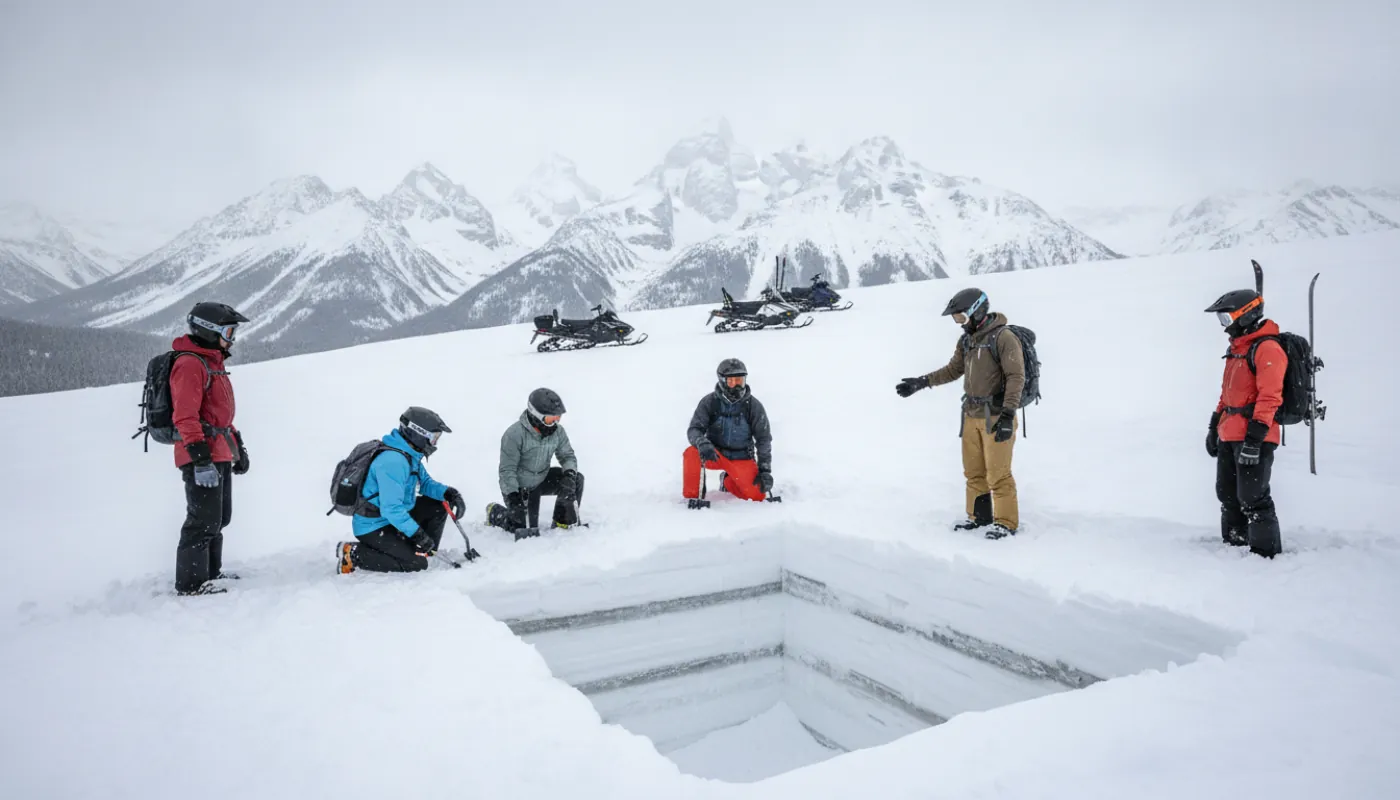
- What you learn: Snowpack analysis. Stability assessment. Slope-scale decision-making. More technical terrain selection. Hands-on snow profiles.
- Format: ~1 day classroom, ~2 days in the field.
- Cost: $500–800.
- Prerequisites: AIARE 1 and AIARE Avalanche Rescue, plus at least one full season of backcountry experience. (Rescue is a formal registration prerequisite, don't skip it and get turned away at the door.)
- Honest take: Take Rec 2 after a season of putting Rec 1 into practice. Taking it immediately after Rec 1 is the most common mistake, you don't have the experience yet to ask the questions the course is built around.
AIARE Rescue Refresher (1 day)
- Who it's for: Anyone returning to the backcountry after a year+ off, or any active traveler who wants to refresh skills.
- What you learn: Companion rescue under instructor scrutiny. New gear and techniques.
- Cost: $150–250.
- Honest take: Take it every 2–3 seasons. Beacon technique decays fast without practice.
The motorized/snowmobile variants
The avalanche-education world has snowmobile-specific versions of each course taught from a sled-mounted-terrain perspective. The curriculum is largely the same, but field travel and decision-making is framed for motorized terrain access (high marking, sidehilling, group spacing in motorized teams).
Take the motorized variant if 50%+ of your backcountry travel is by sled. If you split between ski and snowmobile, the non-motorized version transfers well, but the motorized version has unique content on terrain access patterns.
The professional progression
The professional (PRO) credential is the American Avalanche Association's national standard, audited by A3 and delivered by a handful of approved providers: AIARE is one of them, alongside the American Avalanche Institute, the National Avalanche School, and others. So "AIARE Pro" and, say, "AAI Pro" are the same A3 standard taught by different providers, unlike the recreational courses where AIARE runs its own curriculum.
AIARE Pro 1 (5 days)
- Who it's for: Aspiring ski guides, mountain guides, ski patrollers, snow safety personnel, snowmobile guides, mountain rescue.
- What you learn: Field observation standards (SWAG (Snow, Weather and Avalanche Guidelines), A3's professional observation standard, the one operations use to communicate with each other; not a public-facing framework). Snow stability tests. Operational decision-making. Working in teams. Documentation.
- Format: Mostly field-based with daily reporting and assessment.
- Cost: $1,500–2,500.
- Prerequisites: AIARE 1 + Avalanche Rescue + one winter season of documented backcountry days (20+), plus trip-planning and field documentation. AIARE 2 is not a prerequisite for Pro 1, you can go straight from the recreational level to Pro if you have the field days.
- Honest take: The work-life shift here is real. Pro courses are evaluated, not just attended. Expect homework, daily reports, and an attentive instructor watching how you make decisions in the field.
AIARE Pro 2 (6 days)
- Who it's for: Working snow professionals (forecasters, lead guides, senior patrollers).
- What you learn: Stability evaluation at the operational level. Hazard rating. Mentoring junior staff. Decision-making under stress.
- Cost: $2,500–4,500.
- Prerequisites: Pro 1 + significant working experience.
Continuing professional development
- Annual seminars and workshops: the National Avalanche School (NAS), regional Snow & Avalanche Workshops (SAWs), and the biennial International Snow Science Workshop (ISSW).
- A3 chapter and regional meetings.
- Specialized courses on explosives, helicopter ops, etc.
The order I'd recommend
For a brand-new backcountry traveler in October:
- AIARE Rescue + AIARE 1, ideally bundled, in early-to-mid season. Many providers run rescue Friday + Rec 1 Sat-Sun-Mon.
- Ski with experienced partners in low-consequence terrain for a full season. Practice route-finding, weather observation, beacon practice once a month.
- AIARE Rescue refresher the next fall.
- AIARE 2 in year 3 or 4, when you've started making independent decisions and questioning what you learned in Rec 1.
- Continuing education: annual local avalanche workshops, refreshers, and reading.
If you're planning to enter snow-pro work, add Pro 1 in year 4 or 5 after Pro prerequisites are met.
What no course can teach you
The hardest truth in avalanche education: courses give you frameworks. They don't give you judgment. Judgment comes from time in the snowpack, mentoring with people who have it, and the discipline to walk away from a slope.
A patroller-friend's heuristic: the courses get you to "I know what I don't know." Everything after that is paid for in days on snow.
Cost reality
A serious recreational education progression (Rescue, Rec 1, Rec 2, plus refreshers and equipment), runs $1,500–2,500 spread over 2–3 seasons. That's roughly the cost of a high-end touring setup.
If that math feels backwards, that the education costs as much as the gear, it isn't. The education is what makes the gear survivable.
If you're a backcountry guide or snow professional looking to be listed for course bookings and trips, list your guide service on Ski Hubs, the platform was built for the educator-and-guide tier of the ski industry.